When people notice a new or changing spot on their skin, one of the first things they do is touch it. If something feels different, raised, or rough, it’s a natural warning sign. But relying on texture to identify melanoma is not as reliable as you might think.
Melanoma, the most serious form of skin cancer, can feel smooth, rough, raised, or completely flat, and sometimes there’s no noticeable difference at all compared to surrounding skin.
Keep reading to learn what melanoma actually feels and looks like, what warning signs to watch for, and why a dermatologist’s eye is always worth more than a fingertip check!
What Is Melanoma?

Melanoma is a type of skin cancer that starts in the cells responsible for giving skin its color. These cells, called melanocytes, are found throughout the skin and produce the pigment that creates a tan or a sunburn response.
When melanocytes grow and divide in an uncontrolled way, they can form a cancerous lesion, often appearing as a new mole or a change in an existing one. Melanoma is less common than other skin cancers like basal cell carcinoma, but it’s far more likely to spread to other parts of the body if not caught early, which makes early detection especially important.
How Does Melanoma Feel?
Melanoma does not have a consistent texture. Some lesions are raised and feel slightly bumpy or rough to the touch, while others are completely flat and would be easy to miss without a visual check.
Nodular melanoma, one of the more aggressive subtypes, tends to grow as a raised bump and may feel firm under the skin. Other forms, like superficial spreading melanoma, often start as a flat, discolored patch with no noticeable texture difference at all.
Dr. Dayoung Ko, a board-certified dermatologist at Golden State Dermatology in Los Gatos and Mountain View, explains why touch alone can be misleading:

“Patients often come in and say they weren’t worried about a spot because it felt smooth and didn’t hurt. Unfortunately, that’s not a reliable way to rule out melanoma. Some of the most concerning lesions we see are completely flat and painless. The skin doesn’t always give obvious physical signals when something is wrong, which is exactly why regular professional skin exams matter so much — not just self-checks at home.”
Because texture varies so much, it should never be used as the primary way to assess a suspicious spot. A lesion that feels normal is not necessarily safe, and one that feels rough is not automatically dangerous.
Spotting Melanoma: The ABCDE Criteria
Since touch isn’t dependable, dermatologists rely on a visual checklist known as the ABCDE criteria to identify suspicious moles and lesions. These five markers are the most effective tools patients have for self-monitoring between professional visits.
Asymmetry
A healthy mole is usually symmetrical. So, if you drew a line down the middle, both halves would roughly match. Melanoma lesions are often asymmetrical, meaning one side looks noticeably different from the other.
Border
Normal moles have smooth, well-defined edges. A border that looks irregular, jagged, notched, or blurred is worth paying attention to.
Color
Uniform color, typically a single shade of tan or brown, is a good sign. Multiple shades of brown, black, red, white, or blue within a single spot can indicate abnormal cell activity.
Diameter
Most benign moles stay smaller than a pencil eraser (about 6mm). A spot larger than that warrants a closer look, though melanomas can certainly be smaller when caught early.
Evolution
Any change in size, shape, color, or texture deserves attention. A spot that bleeds, itches, or crusts without a clear reason should be evaluated by a dermatologist promptly.
How Melanoma Is Diagnosed and Treated
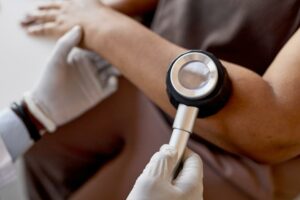
A diagnosis always begins with a proper skin examination. Dermatologists use a tool called a dermatoscope, which provides a magnified, detailed view of a lesion that isn’t visible to the naked eye. If something looks suspicious, the next step is a biopsy, which is the removal of a small sample of tissue for analysis in a lab.
Vanessa Parvez, PA-C, a certified physician assistant at Golden State Dermatology in Berkeley, describes what patients can expect from the process:
“A biopsy sounds intimidating to a lot of people, but it’s a straightforward in-office procedure that usually takes just a few minutes. A small amount of local anesthetic keeps it comfortable, and the tissue sample gives us the clearest possible picture of what’s going on. Getting that information early is what makes the biggest difference in treatment outcomes. Melanoma that’s caught at an early stage is highly treatable — the challenge is that many patients wait longer than they should before coming in.”

Treatment depends on how early the melanoma is caught and whether it has spread. Early-stage melanoma is typically removed through a surgical procedure called excision, where the lesion and a small margin of surrounding skin are cut away. In some cases, Mohs surgery is used for precise removal with minimal impact on healthy tissue. More advanced cases may require immunotherapy or targeted drug therapy to address cancer that has moved beyond the skin.
Your Skin Deserves a Second Opinion

Texture is just one small piece of a much larger picture. Melanoma can feel rough, smooth, firm, or completely ordinary, and that’s precisely why touch is never enough on its own.
The ABCDE criteria are a helpful starting point for self-monitoring, but they work best as a reason to seek professional evaluation, not to make a personal diagnosis. A trained eye, the right tools, and a thorough exam are what make the real difference. Catching melanoma early dramatically improves outcomes, and the most reliable way to do that is through regular skin checks with a dermatologist.
If you have questions about your skin, schedule an appointment at Golden State Dermatology today!